
AI is changing e-commerce faster than ever. Traditionally, shoppers searched Google, visited multiple websites, compared products, read reviews and completed checkout themselves. Now, AI shopping agents are beginning to take over parts of this journey.
An AI shopping agent can research products, compare options, analyze reviews and prices, and in some emerging experiences help complete purchases on a customer’s behalf. Shopify describes agentic commerce as a model where AI agents can handle activities across the shopping journey, from product discovery to purchase.
In 2026, this shift is becoming increasingly important for e-commerce brands. Google has introduced the Universal Commerce Protocol and new merchant tools designed to help retailers participate in agentic shopping, while Amazon is expanding AI-powered shopping experiences through its shopping assistant ecosystem.
For brands, this creates a new question:
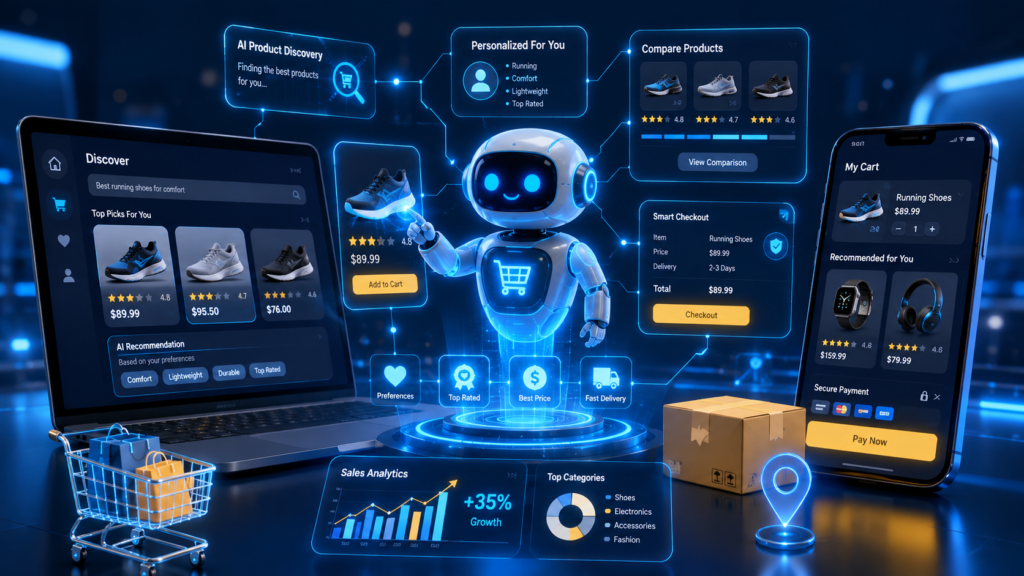
AI shopping agent How do you make your products visible and trustworthy to an AI agent—not just to a human shopper?
1. What Are AI Shopping Agents?
AI shopping agents are intelligent systems that help shoppers make purchasing decisions with less manual effort.
Instead of simply answering a question such as “What are the best running shoes?”, an AI shopping agent can potentially go further by understanding the shopper’s requirements, researching available products, comparing specifications, checking prices and considering reviews.
The traditional shopping journey might look like:
Search → Browse → Compare → Read Reviews → Add to Cart → Checkout
An agentic shopping journey can become:
Tell AI What You Need → AI Researches → AI Compares → AI Recommends → Purchase
The important difference is that the AI is not simply displaying information. It can increasingly reason across multiple pieces of information and take actions on the shopper’s behalf.
However, agentic commerce is still developing. Forrester notes that many current experiences remain conversational, with humans still making important decisions and completing many checkouts themselves.
This means 2026 AI shopping agent is less about replacing traditional e-commerce overnight and more about preparing for a new shopping channel.
2. How AI Shopping Agents Are Changing E-Commerce
AI shopping agents are changing how consumers discover and evaluate products.
1. AI-Powered Product Discovery
Instead of searching through dozens of product pages, shoppers can describe what they want in natural language.
For example:
AI shopping agent “Find me a lightweight laptop under ₹70,000 with good battery life for digital marketing work.”
An AI system can potentially interpret the requirements and compare products based on relevant attributes.
2. Smarter Product Comparisons
AI shopping agents can compare specifications, prices, reviews, availability and other product information much faster than a shopper manually visiting multiple websites.
Amazon’s AI shopping experience, for example, includes features for product insights, comparisons, price history and shopping assistance.
3. Personalized Recommendations
AI shopping agents can use information about preferences and requirements to make recommendations that are more personalized than traditional product listings.
4. Automated Shopping Tasks
In more advanced agentic commerce experiences, AI can help with tasks such as finding deals, building carts and handling routine purchases.
This represents a major shift from “search and click” toward “ask and act.”
3. Why AI Shopping Agents Matter for E-Commerce Brands
The rise of AI shopping agents creates a new form of digital visibility.
For years, e-commerce brands focused heavily on:
- Google rankings
- Product-page SEO
- Paid advertising
- Social media
- Marketplace rankings
- Reviews and ratings
These remain important, but brands now also need to consider how AI systems interpret and recommend their products.
Amazon Ads reported in August 2026 that AI-referred traffic to U.S. retailers had grown significantly year over year in Q1 2026 and that this traffic converted at a higher rate than traditional search traffic.
This suggests an important opportunity.
Your product may no longer need to be discovered only through a traditional search result. It may be discovered through an AI-generated recommendation.
That creates what some marketers are calling the “invisible shelf.” Google Cloud describes this as an additional digital shelf where AI agents discover and evaluate brands and products.
For e-commerce businesses, visibility therefore becomes a combination of:
SEO + Product Data + Reviews + Brand Authority + AI Search Visibility
4. How E-Commerce Brands Can Prepare for AI Shopping
Businesses can start preparing now by improving the information AI systems use to understand their products.
1. Create Accurate Product Data
Make sure product titles, descriptions, specifications, prices, sizes, availability and other attributes are accurate and consistent.
AI agents depend heavily on reliable product information when comparing products.
2. Use Structured Product Information
Organize important product attributes clearly so search engines, shopping platforms and AI systems can interpret them more easily.
3. Strengthen Product Reviews
Reviews can influence how shoppers—and increasingly AI systems—understand product quality and customer satisfaction.
Encourage genuine customer feedback and respond professionally to reviews.
4. Improve Product Content
Avoid vague product descriptions.
Instead of:
“Amazing premium headphones.”
Use specific information:
“Wireless over-ear headphones with active noise cancellation, 40-hour battery life and Bluetooth 5.4 connectivity.”
Clear, factual information makes products easier to understand and compare.
5. Build Brand Trust
AI systems need reliable information to make recommendations.
Consistent brand information, high-quality content, positive customer experiences and trustworthy product data can help strengthen your digital presence.
6. Think Beyond Traditional SEO
Traditional SEO remains important, but e-commerce brands should also consider Generative Engine Optimization (GEO) and AI-search visibility.
A recent August 2026 analysis of agentic commerce emphasizes that retailers need accurate, machine-readable product information because AI systems increasingly act as a new layer between shoppers and products.
5. The Future of AI Shopping Agents and E-Commerce
AI shopping agents could fundamentally change how online shopping works.
Instead of customers spending hours researching products, AI could handle much of the research and comparison process.
Imagine saying:
“I need a comfortable office chair under ₹15,000, suitable for long working hours, with good reviews and delivery within five days.”
Instead of manually opening multiple websites, an AI shopping agent could potentially identify suitable products, compare them and present the best options.
The technology is moving toward this type of experience, although widespread autonomous purchasing still faces important challenges around trust, security, fraud, refunds, returns and user control.
For e-commerce brands, this means the future of visibility may not be limited to:
“Where does my product rank?”
It may increasingly become:
“Will an AI shopping agent understand my product, trust its information and recommend it?”
That is why businesses should start preparing their product data, content, reviews and digital presence today.
Conclusion
AI shopping agents are creating a new chapter in e-commerce.
They are changing product discovery, comparison, personalization and potentially the purchasing process itself. Google, Amazon, Shopify and other major commerce platforms are already developing technologies and experiences around agentic shopping.
For e-commerce brands, the opportunity is clear: prepare for a world where AI becomes part of the customer journey.
The brands that provide accurate product information, strong content, trustworthy reviews and machine-readable data will be better positioned for this emerging AI-driven shopping ecosystem.
The future of e-commerce may not simply be about getting customers to your website. It may be about making sure AI shopping agents know why your product deserves to be recommended.